
Key Takeaways
- Play-based learning enhances cognitive skills such as problem-solving and critical thinking.
- It promotes social and emotional development by encouraging cooperation and empathy.
- Physical play activities support motor skill development and overall health.
- Creativity and imagination are nurtured through open-ended play scenarios.
Table of Contents
- Introduction
- Cognitive Development
- Social and Emotional Growth
- Physical Development
- Creativity and Imagination
- Implementing Play-Based Learning
- Conclusion
Play is more than a way for children to pass the time. In early childhood education, play serves as a powerful tool that nurtures essential skills and lays the foundation for lifelong learning. By weaving play into daily learning experiences, educators give children chances to explore, grow, and express themselves. These opportunities transform classrooms into lively spaces where young minds flourish across all areas of development. Children who participate in intentionally crafted play-based programs, such as an after school program Northridge, CA, are more likely to develop stronger academic, social, and emotional abilities that prepare them for future challenges.
Play-based learning offers significant benefits beyond enjoyment, allowing children to develop relationships, imagination, and vital life skills through interactive activities. When teachers create and facilitate these activities, children gain confidence in exploring new ideas and learning from mistakes. This approach fosters a nurturing educational environment that supports each child’s unique abilities, promoting a positive outlook toward learning. Additionally, play enhances critical thinking and communication skills, crucial for children’s success both academically and personally, making it essential for educators and parents to prioritize play in early learning settings.
Cognitive Development
Problem-Solving and Critical Thinking Through Play
Children’s cognitive skills blossom in environments where play is valued and encouraged. Engaging in pretend play, building with blocks, or participating in group games requires children to use memory, attention, and logic to navigate challenges. Hands-on activities provide practical experiences with sorting, sequencing, and categorizing, helping children understand cause and effect. Play lets children take control of their actions, allowing them to experiment with different solutions in a stress-free atmosphere. This autonomy boosts their confidence in thinking creatively and tackling new problems.
Social and Emotional Growth
Building Relationships and Emotional Resilience
Play-based learning cultivates cooperation and empathy, both of which are essential to emotional intelligence. When children play together, they negotiate roles, resolve conflicts, and learn to recognize others’ feelings. These social interactions build skills such as patience, active listening, and compromise that translate into positive behavior in the classroom and beyond. Structured and unstructured play also provides children with a safe way to manage and express their feelings, helping them cope with disappointment or frustration in supportive environments.
Physical Development
Fine and Gross Motor Skill Advancement
Many play-based activities involve physical movement, strengthening children’s bodies, and developing coordination. Outdoor play, in particular, allows children to climb, jump, run, and balance, supporting muscle growth and heart health. Even small motor activities, such as drawing with crayons or threading beads, enhance dexterity and hand-eye coordination, preparing children for tasks like writing and self-care. These physical skills are essential for future academic and personal success. Regular physical activity during childhood promotes lifelong well-being.
Creativity and Imagination
Nurturing Flexible Thinking and Innovation
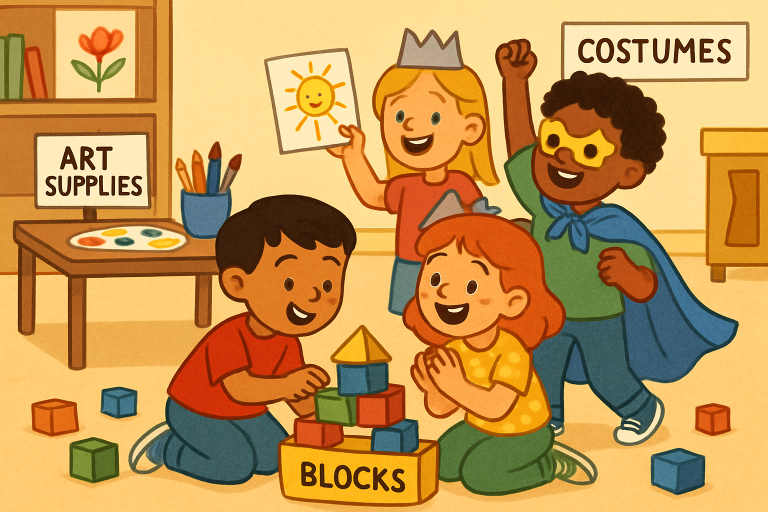
Creative play unleashes children’s imaginations, letting them invent stories, act out scenarios, and use objects in new ways. Open-ended materials blocks, art supplies, and costumes encourage children to make choices and experiment without worrying about right or wrong answers. This process fosters cognitive flexibility, resilience, and a willingness to try new approaches. The skills developed through imaginative play are linked to later achievements in problem-solving and innovation, which are critical in today’s ever-changing world. Through play, children also build a sense of curiosity that fuels lifelong learning.
Implementing Play-Based Learning
Strategies for Educators and Parents
Bringing play-based learning into classrooms or homes involves thoughtful planning and a supportive attitude. Quality teacher preparation programs help educators integrate playful experiences that align with curriculum goals while ensuring all children have the chance to participate and succeed. Teachers and caregivers can set up inviting play areas, rotate materials frequently, and join in the play to model problem-solving and communication strategies. Assessment should focus on observing children’s progress in social, emotional, cognitive, and physical domains rather than only traditional academic measures. For more practical strategies and research-based practices, educators can consult reputable sources such as Edutopia.
Conclusion
Prioritizing play-based learning in early childhood education yields broad-ranging benefits that shape children’s growth across all developmental areas. By nurturing their minds, bodies, and spirits, play prepares young learners for school and for life. As families and educators adopt play-based methods, children develop the vital cognitive, social, emotional, and physical skills they need to become curious, capable, and confident individuals, now and in the years to come.